
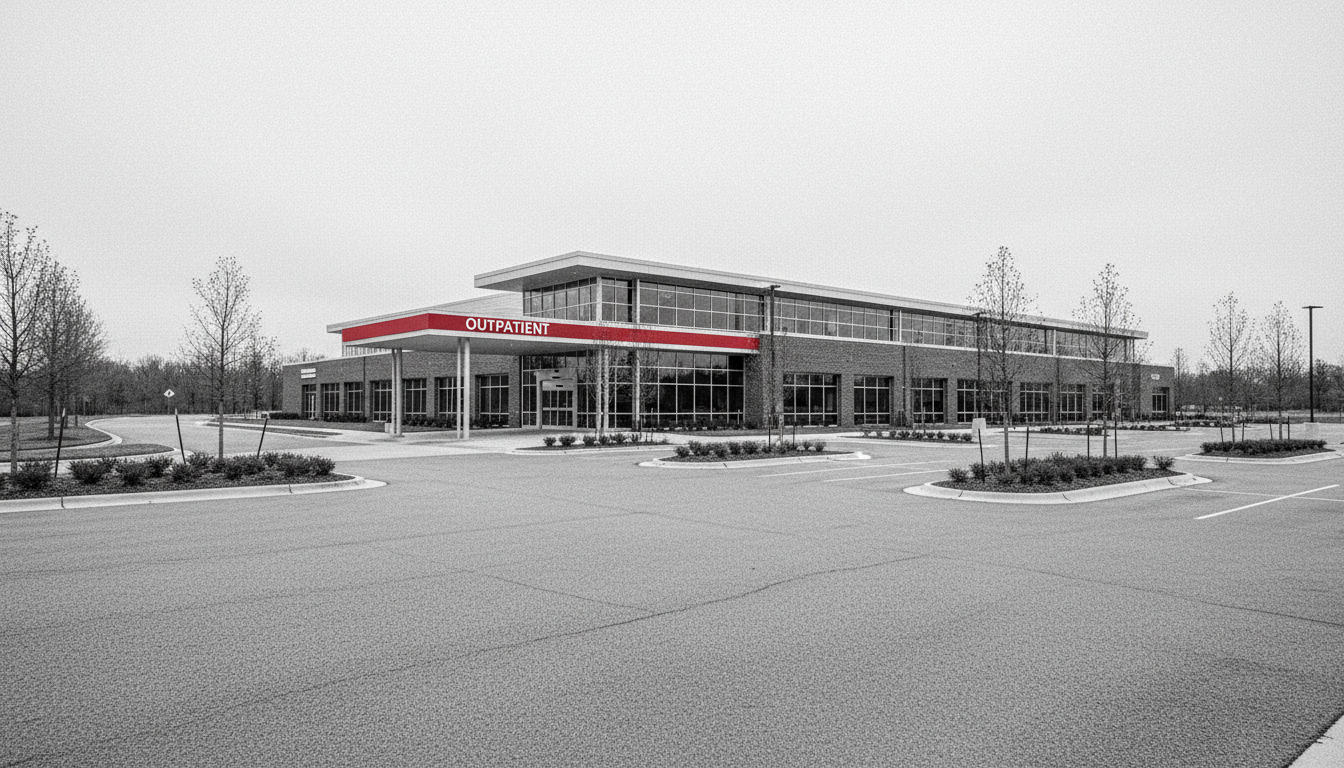
Hospital marketing budgets for 2027 are being set this month, and most of them will open the way they always have: a regional brand campaign at the top and the outpatient sites somewhere below it. I would turn that order over. The growth a hospital is planning for will arrive at its outpatient locations, and the patient who chooses one of those locations decides close to home. The 2027 plan should start with the outpatient map.
Why should a hospital plan 2027 media around outpatient sites?
Because that is where the volume is going. Vizient’s 2026 Impact of Change forecast, released June 30, 2026, projects outpatient volumes up 20 percent over the next ten years while inpatient discharges grow 7 percent. By service line the outpatient growth is steeper: cardiovascular up 29 percent, neurosciences up 27 percent, behavioral health up 22 percent and cancer care up 20 percent, as the American Hospital Association reported from the same forecast on August 4, 2026. And on November 4, 2026, CMS finalized the 2027 outpatient payment rule, removing 637 more services from the inpatient-only list.
The patient’s side of this is simpler. In the U.S. News and World Report 2026 survey of 500 people who had sought care in the past two years, 62 percent said office location was very important for routine care. The decision to use an outpatient site is local, and local decisions are influenced by local media. I wrote earlier this year about out of home media moving closer to the healthcare decision point; the outpatient map is the planning version of the same idea.
What goes into an outpatient site media plan?
Four things, in order. The site list for 2027. The patient origin data for each site, which defines its trade area in ZIP codes and drive time. The service line each site is meant to grow, because a cardiology site and a behavioral health site do not share a media plan. And the local channels that reach each trade area: out of home on the approach roads, radio in the drive times, paid search on the service line and the town name, and streaming video to the trade-area ZIP codes.
The regional brand campaign keeps the system’s name familiar across the market, and it should be funded from what remains after the site plans are set. The measure for the site plans is the appointment, by site and by service line. Impressions tell you the media ran. Appointments tell you the map was right. At DCW Media, the Sun River Health brand relaunch was planned around the regions its 43 centers serve, and the published result was 4,100 appointments booked at $56.24 each.
I have planned and bought media for hospital systems for twenty years through my own company, Laura Maddaloni Inc., a New York State certified WBE, at DCW Media. DCW is an independent, family-run media buying agency, fifty years in, and all of its work is on spec: no retainer, research, reporting or hourly fees. It negotiates added value into the media it buys, and its buying power covers local and national markets.